
Table of Contents
Introduction
The “Right to Disconnect” is a recent legal reform in Australia designed to protect employees’ work-life balance by allowing them to refuse work-related contact outside their normal working hours (calls, emails, messages) unless responding is reasonable. This report examines how this new right affects operations in the Disability and Community Support sector – particularly for National Disability Insurance Scheme (NDIS) providers, who rely heavily on casual workers. We explore the law’s legal context and employer obligations, its impacts on rostering and after-hours service, implications for staff wellbeing and retention, how NDIS providers are implementing the changes (with any guidance available), comparisons with similar sectors (aged care, allied health), and recommendations to comply while maintaining service continuity. Throughout, we prioritize Australian sources, including Fair Work legislation and guidance, NDIS sector insights, and emerging best practices.
Legal and Regulatory Context of the Right to Disconnect in Australia
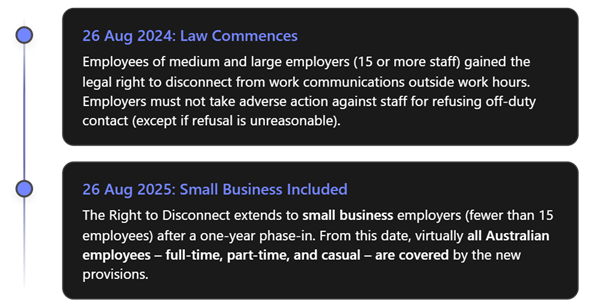
The Right to Disconnect was introduced via amendments to the Fair Work Act 2009 (Cth) as part of the federal Fair Work Legislation Amendment (Closing Loopholes No. 2) Act 2024,
which took effect in stages. In essence, the law grants employees a protected workplace right to ignore or refuse work-related communications outside their contracted working hours (e.g. on a weekend or after a rostered shift) without repercussion, unless refusing would be unreasonable in the circumstances.
Scope and Obligations:
The law applies across all industries and to all types of employees, including casual workers, regardless of seniority or salary. It establishes the Right to Disconnect as a workplace right – meaning an employer cannot pressure, discipline, or disadvantage an employee for choosing not to answer calls or messages off the clock. If an employer takes adverse action (e.g. reducing shifts or terminating employment) because a worker didn’t respond after hours, the employer could face legal consequences under Fair Work’s general protections and potential penalties.
However, the right is not absolute. The legislation recognises that there are situations when contacting an employee (and expecting a response) outside normal hours is justified. An employee’s refusal to engage after hours can be overridden if it is considered “unreasonable” in context. Key factors in determining reasonableness – now spelled out in the law – include:
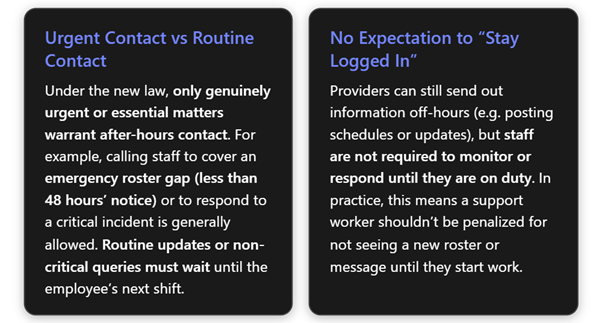
- Why the contact was initiated: If there is an emergency or urgent matter (e.g. a critical client incident or a shift that needs filling immediately), it may be reasonable for the employer to expect a response. Routine matters or FYIs, by contrast, generally can wait until the next working day.
- How contact is made & its disruptiveness: A single text may be less intrusive than repeated phone calls late at night. Frequent or aggressive after-hours contact (like multiple calls and angry voicemails about a non-urgent issue) would favor the employee’s right to ignore it.
- On-call compensation or overtime: If an employee is being compensated to be available – for example, receiving an on-call allowance or paid overtime – then refusing to respond is more likely to be deemed unreasonable. Essentially, paid on-call staff are expected to answer when called.
- Nature of the employee’s role and seniority: Higher-responsibility roles (e.g. a crisis manager or on-call nurse) might have a broader expectation of availability, whereas a junior support worker has more right to uninterrupted personal time. A manager might reasonably be contacted for urgent decisions, but a casual support worker shouldn’t be routinely bothered at home.
- Employee’s personal circumstances: Factors like family caregiving duties, health conditions, or remote location (e.g. out of mobile range) are relevant. For example, if a casual worker is off-shift caring for children or is in an area with no reception (and thus misses a call), it bolsters the reasonableness of not responding.
Importantly, the law does not outright ban employers or clients from attempting to reach a worker after hours – rather, it empowers employees to not engage in their personal time [1]. There is also a explicit exemption for legally required contact: if a law mandates that an employee be reachable or provide information (for instance, emergency services personnel during a crisis, or a mandated report that must be addressed), the employee cannot refuse that contact.
Application to Casual Workers:
Casual employees have the same right to disconnect as permanent staff, but its practical application raises unique issues. By definition, casuals have no guaranteed hours; many rely on calls or texts offering shifts. Under the new law, a casual cannot be forced to monitor their phone off-duty for work offers, and they can’t be penalized for ignoring a message that comes at 10pm about a shift the next morning. This is a significant change, as previously there may have been an expectation (implicit or explicit) that “good” casuals stay reachable to maintain favor for more shifts. Now, that expectation must be tempered. Employers still can contact casuals about available work after hours, but the casual has a protected right not to respond until they are back on duty.
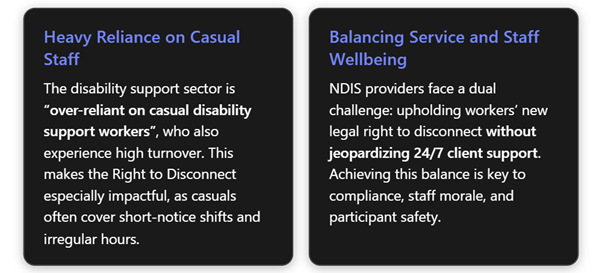
Industry leaders have pointed out a potential tension here: disability services often need to fill shifts on short notice (e.g. a support worker calls in sick at the last minute), which traditionally meant ringing around a pool of casuals at odd hours. Anne Nalder of the Small Business Association of Australia noted “complications for casuals, as there are times when someone is sick and cannot report for work, resulting in the employer having to call an employee potentially after hours”. In other words, the very nature of casual staffing and 24/7 care can conflict with the new boundaries. The law’s reasonableness test does account for genuine last-minute needs (which we discuss below), but fundamentally, it pushes employers toward more structured solutions than simply expecting casuals to answer calls at any time.
Modern Award Provisions:
To give further clarity at the workplace level, the Fair Work Commission is updating all Modern Awards (including the SCHADS Award, which covers many disability support workers) to include Right to Disconnect clauses. In the Social, Community, Home Care and Disability Services (SCHADS) Award, it’s expected to explicitly state that certain scenarios do not breach the right to disconnect. Draft updates indicate that an employer may require a worker to monitor or respond to contact in situations such as:
- The employee is paid a stand-by (on-call) allowance and is being called in to work or respond to an urgent matter (i.e. they are in an agreed on-call status).
- There is an emergency change in roster with under 48 hours’ notice – for example, a shift needs filling for the next day due to unexpected absence. Contacting staff to fill this emergency shift is considered reasonable.
- The employee is being recalled to the workplace to respond to an incident (common in residential care settings when an extra pair of hands is suddenly needed).
Outside of such situations, any contact beyond working hours is truly optional for the worker. Employees can ignore calls/messages during their time off, and employers must accept that outcome in most cases. In practice, this means NDIS providers should not expect casual (or any) staff to constantly check their phone or email after clocking out. The Fair Work Ombudsman emphasizes that employees now have the right to unplug – they “may refuse to monitor, read or reply” to out-of-hours communications from their employer or even from clients/third-parties. For NDIS providers, that includes communications from participants or their families: if, say, a client texts their support worker on a Sunday about scheduling, the worker is under no obligation to respond until they’re back at work.
In summary, the Right to Disconnect law in Australia (effective 2024/2025) imposes a new duty on employers to respect staff downtime. All workers – including casual disability support staff – now have legally backed freedom to decline after-hours contact. Employers must not retaliate against those who exercise this right, and they need to assess “reasonableness” before expecting any off-shift answers. This legal backdrop sets the stage for significant changes in how NDIS providers manage rostering, emergencies, and communications.
Operational Impacts on NDIS Providers (Rostering, After-Hours Contact, Continuity)
Implementing the Right to Disconnect in an NDIS service environment raises practical questions: How do we cover 24/7 support requirements if staff don’t have to answer their phones? How will rostering and on-call arrangements need to change? And how can providers maintain service continuity and emergency responsiveness without breaching the new rules? This section assesses these operational impacts, focusing on areas like scheduling, after-hours communication protocols, and handling urgent client needs.
Rostering and Shift Scheduling
NDIS services often have fluctuating staffing needs – participant cancellations, last-minute service requests, or employees calling in sick. Traditionally, many providers managed this through ad hoc phone calls or texts to casual staff to fill gaps. The Right to Disconnect doesn’t forbid such calls, but it shifts the paradigm: staff can legitimately ignore a 7pm phone call offering them a shift the next morning. Therefore, providers must adapt their rostering processes to reduce last-minute scrambles:
- Plan rosters well in advance: The more you can schedule shifts ahead of time, the less you’ll need to contact staff on short notice. Providers are encouraged to use scheduling tools or workforce management software to publish rosters with plenty of notice. For example, an NDIS provider might release next month’s schedule a few weeks early. If that roster is posted on an app or emailed after hours, it’s fine – what’s new is that support workers are under no obligation to check or acknowledge it during their time off. They can review it when back at work. This requires management to shift expectations – e.g. if a roster is changed over the weekend, a worker might not see the change until Monday morning, so contingency plans are needed if someone doesn’t show up due to not seeing an updated shift.
- Use availability and preference data: Many casual workers appreciate flexibility. Providers can leverage systems where staff indicate their availability in advance (days/times they are open to accept shifts). Then, if an urgent need arises, managers can focus their calls on those who have signaled they’re willing to be contacted. Some NDIS providers are using apps that allow carers to set their available hours and even claim open shifts digitally, reducing the need for direct calls or messages outside work hours. This respects the right to disconnect for those who are truly off, while still tapping those who want extra work.
- Emergency roster changes under 48 hours: Despite best planning, short-notice changes are sometimes unavoidable (e.g. a support worker calls in sick overnight for a morning shift). Recognizing this reality, the SCHADS Award update proposes that contacting employees for an “emergency roster change” with less than 48 hours’ notice will not violate the disconnect right. In practice, this means if you must find a replacement for tomorrow, you can reach out after hours to available staff. The expectation of reasonableness is on your side in such emergencies. That said, staff can still decline the shift if they’re unavailable – but merely contacting them in this scenario is considered appropriate. NDIS providers should define what qualifies as an “emergency shift change” (generally sudden illness or unforeseen unavailability) and ensure managers don’t overuse this exception for trivial reasons.
After-Hours Communication Protocols
Providers will need to establish clear policies for out-of-hours contact: Who can be contacted, by whom, and for what reasons? Key adjustments include:
- Formalising On-Call Roles: In disability services, it’s common to have a manager or senior staff member “on call” after hours for critical issues. Under the new regime, it’s advisable to make on-call arrangements explicit and compensated. For example, an NDIS group-home provider might designate a rotating on-call coordinator each weekend, with a set allowance, whose job is to handle any client emergencies or find last-minute replacements. Since that person is paid to be on standby, contacting them is permissible and they are expected to respond. By contrast, other staff not on call should generally not be disturbed. This centralises urgent after-hours work to specific individuals (with their agreement), ensuring others can disconnect.
- Defining Emergency vs. Non-Emergency: Each organisation should define what counts as an “urgent” contact worthy of breaking someone’s off-hours. Examples of likely urgent issues: a participant’s safety is at risk, a client has no support worker showing up, a time-sensitive incident (e.g. police or hospital involvement) occurs, or a shift within the next day needs coverage. Non-urgent: discussing next month’s roster preferences, routine updates, and minor issues that can wait. The allied health sector, for instance, has advised clinics to establish clear policies distinguishing urgent communications from routine matters – e.g. “a casual therapist needs to know if their next-day appointment is cancelled (urgent), but a general FYI or meeting invite can wait”. NDIS providers similarly should create guidelines or decision trees for managers: if the issue can wait until business hours, it waits. If it truly cannot, then contact an on-call person or, if none, contact the least number of off-duty staff necessary.
- Limiting Disruptive Contact Methods: If after-hours contact is necessary, consider the least intrusive means. A single text message that someone can choose to ignore until morning is less disruptive than a phone call that demands immediate attention. The Fair Work Commission notes that how you contact matters in judging reasonableness. Best practice might be: use a phone call only for critical, time-sensitive emergencies; otherwise, an email or message can be sent (and the employee will handle it later at their discretion). Also, avoid multi-channel blasts (e.g. simultaneously texting, calling, emailing, and WhatsApp messaging a worker to get their attention – that would likely be viewed as unreasonable employer conduct).
- No Repercussions for Non-Response: Operationally, managers must adapt to the possibility that an off-duty worker may not respond at all. If a casual support worker doesn’t answer a 9 pm call to cover a shift, supervisors should not reprimand them later – that is their right. Nor should they slyly give that worker fewer future shifts as punishment (that could constitute adverse action and is unlawful). Instead, organisations might develop a backup plan: e.g. if no one responds in an emergency, a management staffer might step in or alternative arrangements are made (perhaps engaging an on-call agency or asking a current on-shift employee to do overtime voluntarily). It will be important to foster a culture where not answering after hours is normalised and not seen as letting the team down.
Service Continuity and Emergency Response
A critical concern for disability support providers is maintaining client care, especially for participants with high needs or 24/7 support requirements, in light of staff disconnecting. Providers remain responsible for participant safety at all times, so they must reconcile the Right to Disconnect with their duty of care. Some points to note:
- Participant well-being and safety plans: NDIS providers are obliged under NDIS Commission standards to ensure continuity of critical supports, including during emergencies. This means having robust contingency plans if a worker is unavailable. For example, a group home provider should have an after-hours on-call plan: if a night shift worker doesn’t show up, there is a procedure (maybe the on-call manager or a float worker can attend). The Right to Disconnect reinforces that this plan cannot solely rely on hoping one of the off-duty casuals picks up the phone at 10pm. Instead, it likely requires a roster of designated backup staff who have agreed to be reachable.
- Dedicated emergency contact point: It’s wise to channel all after-hours emergencies through a single contact number or person, rather than individual client families calling individual support workers at home. For instance, an NDIS provider might set up an after-hours hotline for participants (or their families) which is staffed by the on-call coordinator. That coordinator can then triage the situation and decide which employee to contact, if any. This prevents situations where well-meaning clients directly ring their favorite support worker at night – something that now puts the worker in a position to ignore the call (which could worry the client). By educating participants and families to use official channels, providers both comply with the law and ensure clients aren’t left without guidance. (It’s noteworthy that aged care providers are being advised to “clearly set out the times and channels when employees will be available and when they will not” to residents and their families, and to protect staff from encroaching third-party contact after hours. The same applies in disability support – e.g. let participants know support workers won’t answer personal calls off-shift, and provide an alternative contact for urgent issues.)
- Adjusted emergency protocols: In true emergencies (medical emergencies, critical incidents), on-duty staff will handle immediate response as they always have (call ambulance, etc.). But if additional support or management input is needed, ensure that managers know whom to call without breaching others’ disconnect rights. As mentioned, an on-call manager system is ideal. If that’s not feasible, set up a voluntary emergency response team – a list of staff who have volunteered (possibly with extra pay or time-in-lieu incentives) to be contacted after hours if something dire happens. This should be rotational to avoid overburdening the same people.
- Documentation and handovers: Emphasise good documentation and shift handover practices so that urgent information is less likely to be missed. For example, if a potential issue is brewing (a client’s health is declining, or a staff might not make their next shift), that should be flagged and handed over to whoever is monitoring after hours, before everyone clocks off. Good communication within work hours can reduce the need for surprise calls later.
NDIS providers will need to professionalise and formalise their after-hours handling. The days of simply ringing a dozen casuals at 6 am to find a replacement might be over – or at least, you cannot expect an answer. Providers are responding by improving rostering lead times, using on-call rosters, and clarifying what constitutes an “emergency” contact. By doing so, they can honour staff’s right to disconnect while still ensuring clients receive the support they need.
Maintaining service continuity in disability support will require creativity and planning, but it’s achievable. Many organisations are finding that these changes (like better planning and clearer protocols) can actually streamline operations in the long run. The next section looks at how these operational shifts tie into worker wellbeing and organisational risk management.
Workforce Wellbeing and Risk Considerations (Burnout, Retention, Flexibility vs Availability)
One of the driving intents behind the Right to Disconnect is to protect employees’ mental health and wellbeing. In sectors like disability support – known for demanding work and risk of burnout – these laws could be a double-edged sword operationally, but potentially a boon for worker welfare. Here we examine how the new right influences staff wellbeing (stress levels, burnout, job satisfaction) and workforce stability (retention and recruitment), especially for casual workers. We also consider the risks and trade-offs, including any tension between flexibility and availability.
Staff Wellbeing and Mental Health
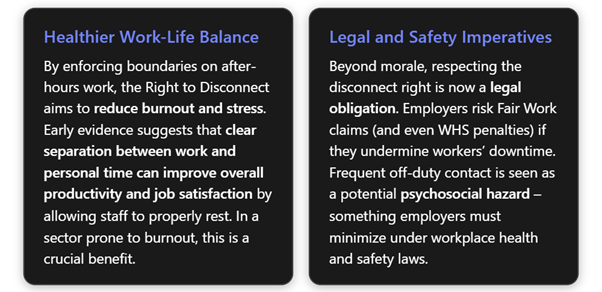
Frontline disability support can be both physically and emotionally taxing. Many support workers juggle irregular hours or multiple jobs, and burnout has been a persistent issue in the sector. The Right to Disconnect directly addresses one contributor to burnout: the feeling of being “always on” or constantly available to work. By affirming that personal time is truly personal, the law supports employees in recharging. Expected positive impacts include:
- Reduced burnout and fatigue: Continuous connectivity to work, via smartphones and apps, has been linked to stress. Now a support worker can finish their shift and truly log off mentally. Not having to worry about “Will my boss call me to come in tomorrow?” every evening can markedly reduce anxiety. Employers and consultants note that clear boundaries ultimately enhance productivity by preventing overwork. In other words, a well-rested support worker is more effective and present during their actual working hours. Organizations that implemented disconnect policies overseas have seen benefits like improved focus and lower absenteeism due to stress – Australian providers may see similar outcomes over time.
- Improved job satisfaction: Work-life balance is a key driver of job satisfaction in care professions. Knowing that the employer respects your time off builds goodwill. Particularly for casuals, who historically might feel pressured to accept any hour offered lest they fall out of favor, this right can empower them to set boundaries without fear. That empowerment – having more control over when you work and when you don’t – can make the job more attractive to many workers. It turns the “always available” expectation into a more mutual flexibility (the worker can say no, not just the employer say yes or no to offering shifts).
- Better mental health: The Australian Public Service Commission and mental health organizations have heralded the Right to Disconnect as an “anti-burnout” measure that can reduce stress-related mental health issues. In disability support, employees often deal with challenging client situations; truly being off-duty means they get a psychological break to decompress. This is especially valuable for workers with their own disabilities or health conditions, as noted in one analysis – the ability to disconnect allows time for self-care and managing personal health needs without the pressure of work intruding.
That said, it’s important to recognize individual differences. Some staff (perhaps a minority) actually enjoy the extra hours or being “in the loop.” For example, an enthusiastic casual might want to know immediately if a shift opens up so they can earn more. The law doesn’t forbid this – if an employee wants to engage off-hours, they can. But the employer must ensure it’s truly voluntary and not an implied expectation. Some providers may allow employees to opt in to after-hours contact (say, by signing up for a text-alert system for available shifts), which can provide flexibility while still respecting those who opt out. The key is that the default has flipped: downtime is protected unless the worker chooses otherwise, whereas before it was often expected unless the worker objected.
Flexibility vs Availability for Casuals
Casual employment is valued for flexibility – usually meaning the worker can accept or decline work as suits them. However, in practice, many casuals felt they had to remain available at short notice to get enough hours. The Right to Disconnect strengthens the casual’s hand in this balance. It could have two effects:
- Empowering casual workers to set boundaries: Casual support workers can more freely decline calls or ignore messages when it’s their time off, without worrying that they’ll be seen as unreliable. This might encourage a healthier balance and prevent overwork (some casuals string together too many hours across providers, leading to fatigue). It also helps those with other life commitments (study, family) – they no longer need to apologize for not answering the phone during dinner or class. Ideally, this contributes to retention by making casual roles more sustainable long-term, instead of people burning out after a short stint.
- Need for proactive engagement mechanisms: On the flip side, providers might develop systems where casuals proactively indicate when they are open to work extra. For instance, a casual could update an app with “I’m free to work extra on Saturday if needed.” This shifts from passive availability (waiting by the phone) to active planning. Casuals still get flexibility, but the organization isn’t left completely in the dark either. In effect, the law nudges both parties to communicate better about availability in advance, rather than last-minute.
There is a potential risk that needs monitoring: Some workers could feel financial trade-offs. If a casual strictly disconnects and never takes last-minute shifts, they might end up with fewer hours (since the employer fills needs with someone else who was reachable). Over time, if not managed carefully, this could create tension – the law says you can’t punish someone for not answering, but practically a worker who often says “no” might just get asked less. To avoid perceptions of favoritism or indirect penalty, providers should distribute opportunities fairly (perhaps rotate who gets called first for shifts, or use an automated system to offer shifts to all available staff simultaneously so it’s their choice to grab it or not). Transparency in how extra shifts are allocated will be key to ensuring the right to disconnect doesn’t inadvertently disadvantage those who exercise it. Unions have cautioned that workers who assert boundaries should not be seen as “less committed” – a mindset change for some managers.
Retention and Attraction
The disability sector faces chronic workforce shortages. Any change that improves conditions could help retain staff or attract new entrants. By reducing burnout and demonstrating respect for employees’ personal lives, the Right to Disconnect might improve retention. For example, a support worker might be less likely to quit if they no longer receive calls on every day off. In the NDS Workforce Census, turnover among casual disability staff was extremely high (24% in 2023). High turnover is costly and affects service quality. If the new law even marginally reduces burnout-related resignations, that’s a win for providers.
Additionally, promoting your organization as one that honors the right to disconnect could be a selling point when recruiting. It signals a progressive, employee-friendly culture. In an era where workers increasingly value work-life balance, this could differentiate a provider in the labor market (much like offering flexible scheduling or wellness programs does).
Risks and Challenges
While the benefits to wellbeing are clear, there are some concerns to watch:
- Enforcement and cultural change: If managers or schedulers have a habit of contacting staff arbitrarily, it will take training and culture change to stop that. Any manager who continues to message employees at all hours “as usual” not only undermines wellbeing but also exposes the organisation to disputes. Employees who used to grin and bear it may now officially push back. There is a risk of initial friction or disputes as everyone adjusts – e.g., a worker might refuse a call they deem non-urgent, but the manager thought it was Such conflicts need to be handled carefully (the Fair Work Commission can mediate if needed and has broad powers to order a resolution if either party is being unreasonable). To mitigate this, providers should educate both staff and managers about what is considered reasonable, ideally capturing common scenarios in guidelines or training.
- Operational strain and fairness: As noted earlier, if not done carefully, the burden of after-hours responsiveness might fall on a few individuals (like those on-call managers or a few “go-to” staff who don’t mind extra work). Those people could then experience increased fatigue, even if they’re compensated. It’s important to rotate on-call duties and ensure no one person is overused. Also, ensuring that those who volunteer for more work aren’t exploited is key – there should still be limits to prevent them from burning out too.
- Perception of service impact: Some stakeholders (perhaps clients or even some staff) might worry that “things won’t get done” or clients will be left hanging due to these new rules. Management needs to reassure that client safety remains paramount and that the organisation has structures to handle issues. This isn’t so much a direct risk, but a communication challenge: maintaining trust that the provider can manage emergencies and respect staff rights. Over time, as new systems prove themselves (for instance, showing that emergencies were handled fine via the on-call system), these worries should ease.
- Flexibility for workers vs. consistency for clients: Casual workers often value choosing when they work, and clients value seeing familiar support staff. If casuals now choose to disconnect more, they might decline shifts they might have earlier accepted out of a sense of obligation. This could lead to a different casual taking that shift, meaning clients see a greater variety of carers (less consistency). It’s a minor point, but continuity of care is important in disability services. One solution is to encourage more casuals to convert to part-time (since the same legislative reform also made conversion easier), thus stabilising the workforce. Part-time staff would have set rosters, reducing last-minute changes altogether. In the long run, the push to disconnect could pair with a push to offer more permanent roles, which would improve consistency for participants and job security for workers.
Health & Safety and Liability
Worker wellbeing isn’t just a “nice to have” – it’s increasingly seen as a compliance issue under workplace health and safety (WHS) law. Mental stress from overwork or constant intrusion can be considered a “psychosocial hazard”. Regulators (like Safe Work Australia and state WHS agencies) now expect employers to manage psychosocial risks similar to physical hazards. If an NDIS provider fostered a culture where staff felt they must respond 24/7, it could be construed as creating a psychosocial risk (leading to burnout or anxiety). In fact, legal experts warn that employers could face action if their policies (or lack thereof) around after-hours contact cause psychological harm. Conversely, implementing Right to Disconnect is a control measure that helps mitigate that risk. It sets a boundary to prevent work encroaching excessively on rest, which is protective of mental health.
There’s also the legal risk of adverse action claims: if a worker feels they were punished for not answering calls on a weekend (e.g., fewer shifts given), they could lodge a general protections claim. The onus would be on the employer to prove that it was not retaliation. Such claims can result in substantial penalties or compensation. Already, as noted in the media, a teacher in Queensland has sued for around $800,000, alleging they were penalised for failing to respond to work communications during holidays. This shows the teeth behind the legislation; it’s “not just symbolic” and can have real financial impact if employers get it wrong. NDIS providers should heed these examples – establishing clear disconnect practices is as much about legal risk management as it is about wellbeing.
The Right to Disconnect should bring notable benefits to disability support workers’ well-being: more restful time off, less intrusion of work into personal life, and ultimately a healthier, more sustainable workforce. For providers, investing in these improvements can pay off through better retention and an engaged staff. But it requires attentive implementation to ensure that flexibility (a hallmark of the sector’s employment model) remains and that no new inequities or service lapses arise. With thoughtful policies, the law can strike the intended balance: supporting staff wellbeing while maintaining client care, rather than one at the expense of the other.
Sector-Specific Implementation by NDIS Providers
How are NDIS providers actually putting the Right to Disconnect into practice? Given the unique operating context (clients with disabilities requiring reliable support, often on a 24/7 basis, and a workforce that is highly casualised), providers have been actively seeking guidance and developing strategies to comply with the law. This section looks at interpretation and implementation within the disability support sector – including any available guidance from the NDIS Quality and Safeguards Commission or industry bodies – and real-world adjustments made by providers.
Industry Guidance and Sector Responses
The introduction of the Right to Disconnect has not gone unnoticed in the disability services community. Sector bodies and consultancies have been quick to offer advice tailored to NDIS providers:
- NDIS Commission and Quality Standards: The NDIS Quality and Safeguards Commission itself has not issued specific directives about the Right to Disconnect (as it’s fundamentally an employment law issue under Fair Work). However, the Commission’s existing standards stress “continuity of supports” and emergency planning, meaning providers must ensure critical participant needs are met even outside normal hours. Thus, while the Commission doesn’t say “do X or Y about after-hours contact,” it implicitly expects providers to have robust systems (e.g., documented on-call procedures) so that participants aren’t left without care due to workers rightfully disconnecting. In practice, NDIS audit criteria for emergency and disaster management require evidence that providers can maintain support continuity in crises [2]. Post-law, auditors might look to see that providers have updated their policies to reconcile this with staff rights (for instance, showing that there’s always a designated responder for after-hours incidents, rather than assuming anyone can be reached arbitrarily).
- Sector associations (e.g. NDS): National Disability Services (NDS), the peak body for non-government disability providers, has been raising awareness of workforce reforms. In its communications, NDS highlights changes like the closing loopholes legislation and encourages members to update their HR policies accordingly. While specific internal guidance might be member-only, we know NDS emphasises the need to address workforce challenges (like high casual turnover) with better practices. The Right to Disconnect dovetails with broader workforce initiatives like improving job quality. We can infer that NDS and similar bodies likely advise creating clear disconnect policies and training sessions for managers in the sector.
- Professional advice and templates: Ready-made solutions are being offered to providers. For example, the Provider Institute (an NDIS-focused consultancy) has even developed an “NDIS Right to Disconnect Policy and Procedure” template for organisations to adopt. This indicates that many providers are formalising this right in their workplace policies. Such a policy typically outlines: scope of the right, examples of reasonable vs unreasonable contact, the procedure for on-call or urgent situations, and how staff can raise concerns. By purchasing or developing a policy template, NDIS businesses signal their commitment to embedding the changes organisation-wide.
- Operational training and forums: In late 2023 and 2024, webinars and workshops became available for community sector leaders. For instance, HR firms and legal experts have run sessions on implementing the right, often using scenarios specific to care services. In these forums, common interpretations are shared – like how to handle scenarios of participant distress or how to negotiate new expectations with employees. The Diversity Council Australia and other advocacy groups have also promoted the benefits of the right for inclusive workplaces (noting it’s particularly helpful for employees with disabilities or caring responsibilities), which is very relevant in this sector where many workers are women with family responsibilities.
Changes at the Provider Level
Anecdotally, many NDIS providers are adapting their internal processes. Some changes being reported or recommended include:
- Policy Updates: Nearly all providers with employee handbooks or HR manuals are inserting a section on the Right to Disconnect. This typically references the Fair Work Act provisions, affirms employees’ right to not respond off-hours, and instructs managers and clients on appropriate contact times. The policy might list the specific exceptions (mirroring the Award: emergencies, on-call, etc.) and require that any after-hours contact be approved or justified. Simply having this in writing is a big shift – it puts everyone on the same page and gives employees confidence that disconnecting isn’t “letting the team down,” it’s following company policy.
- Employment Contracts and Agreements: Some NDIS providers are reviewing contract terms. For example, if any employment contracts had clauses like “the employee may be required to respond to calls outside normal hours as needed,” those are being revisited to ensure compliance. New contracts for roles that do require on-call duties explicitly state the expectation and the compensation for it, aligning with the law (since if it’s explicit and paid, it’s reasonable). Conversely, contracts for standard roles now often clarify normal working hours and might even mention the right to disconnect to signal compliance. Notably, if an NDIS provider has an Enterprise Agreement (EA) with staff, they should check if it has any disconnect clause; if it provides a better right (say, stricter limits on contact than the Act), that EA clause prevails. Unions in the sector (like the Australian Services Union) may push to include strong disconnect provisions in future EBAs as well.
- Manager Training and Communication: A major part of implementation is educating service managers, coordinators, and team leaders. They are the ones who would typically be contacting staff. Many organisations have held internal briefings to explain the new rules. Managers are learning to triage issues better and to resist the reflex to call staff for minor things. They’re also being trained on how to talk to staff about availability in a way that doesn’t pressure them (e.g., asking for volunteers for shifts rather than voluntelling someone). The aged care sector advice was to “brief all staff with supervisory responsibilities on the right to disconnect and their obligation to ensure after-hours contact is reasonable” – NDIS providers are doing likewise. This might include workshops with role-playing scenarios: Is this situation urgent enough to call Jane at 8 pm? If not, what should you do instead? Building that judgment is crucial.
- Client/Participant Communication: As mentioned, some providers are directly informing clients and families about the changes. For instance, a disability day program provider might send out a newsletter to participants’ families stating: “We value our staff’s well-being and comply with new Fair Work laws that give them the right to disconnect. Our staff will not answer calls or emails outside work hours unless it’s an emergency. If you need to contact us after hours, please use our main office line, and an on-call manager will assist.” This sets expectations and helps avoid families inadvertently placing staff in a tough spot. It also underlines professionalism – families know there’s a system to deal with issues, rather than informal access to staff at any time. Maintaining consistency here is key; if even one or two families keep contacting workers informally at night, it can create pressure or confusion. So providers are working on boundary-setting with service users (in a respectful way that also highlights that staff need rest so they can do their best in scheduled hours).
- Technology and Tools: Another facet is leveraging technology to facilitate compliance. Some providers encourage the use of scheduling apps where notifications can be controlled. For example, a support worker app might have a “Do Not Disturb” mode that workers can activate when off-duty, so they don’t even see messages until they log in next. Employers are fine-tuning such settings. Email protocols are also being adjusted – e.g., urging staff to use delayed-send features if they draft emails after hours, so that colleagues don’t feel they have to read or reply at night. These small tech adjustments foster a culture in line with the disconnect principle. Additionally, automated out-of-hours replies are being adopted on shared inboxes or staff phones, e.g. a text back saying “You’ve reached \[Provider]. Our offices are closed, and staff may not respond until working hours. If this is urgent, call XYZ.” These responses serve both as a courtesy and a shield for staff.
- Case-by-Case Flexibility: The sector is also learning that one size may not fit all. Some providers are handling special cases individually. For instance, a support worker who is also a live-in caregiver might actually prefer to get a nightly check-in call regarding the client they live with – so maybe an arrangement is made that differs from the norm, with their consent. Or a casual who wants to maximise hours might give consent to be contacted anytime; the provider can allow it, but likely still ensures anything truly optional waits. Essentially, while the policy provides a baseline, implementation can allow opt-ins for those rare instances, ensuring it’s the employee’s choice. All such agreements should be documented (to protect that it’s voluntary) and can be revoked by the employee.
Early Challenges and Adjustments
Some NDIS providers, after initial implementation, reported hiccups such as:
- Confusion about what is “reasonable” contact. For example, one coordinator might err on the side of caution and not contact anyone even when perhaps they should have (like a moderately urgent situation that then got worse). Meanwhile, another might have over-contacted. To address this, teams have been sharing experiences and refining guidelines. Some have created an “escalation matrix” – a simple table or flowchart: If X happens, then Y person calls Z role. This removes the guesswork on whether it’s justified to call someone.
- Ensuring 24/7 services (like supported independent living residences) have continuous coverage without breaking rules. Many such services already had on-call systems, but if not, they have now instituted them. Providers realised that without a formal on-call, they were relying on favours from staff, which is no longer tenable. So they budgeted for on-call allowances or arranged manager rotations for weekends, etc. In some cases, this required hiring or reassigning staff to fill those coordinator roles, which is a cost. But given the potential cost of non-compliance (legal or lost staff), it’s seen as a necessary investment.
- Some casual staff initially missed communications about shifts because they rightly didn’t check messages off-duty. For example, a roster changed on short notice, but the worker didn’t see it until too late, causing a no-show. To fix this, providers improved how they notify about roster changes: e.g., if a shift time is changed with less than 48 hours’notice, they now call during work hours or ensure explicit acknowledgment from the worker beforehand. Essentially, last-minute changes now trigger more careful handling – either treat it as an emergency contact (with a direct phone call and confirming the person is aware, since that’s allowed) or avoid such changes. Over time, these processes reduce those incidents.
- Feedback from staff has generally been positive – many feel a sense of relief and validation. However, a few employees expressed concern about being harder to reach if they need to get a message to management after hours (it goes both ways – e.g., a staff member might have tried to call a supervisor about a client issue and found the supervisor didn’t answer because they were off-duty). This flipside is addressed by clarifying on-call roles: staff on duty always have someone they can escalate issues to, even if it’s not their direct supervisor. It might require a mindset change that you won’t always get your manager, but you’ll get the on-call manager. As long as the handover is smooth, this is workable.
The NDIS sector is actively working through the implementation of the Right to Disconnect. Providers are updating policies, training people, and tweaking operations, often drawing on guidance developed for similar care industries like aged care. The emphasis is on clear communication and formal structures: making sure everyone (staff, managers, and clients) knows when and how contact is appropriate. Early adopters have found that, with these measures, the sky hasn’t fallen – services continue, and staff appreciate the respect for their personal time. Next, we’ll compare notes with a couple of related sectors to see how they handle similar challenges, which can offer further insight or best practices for NDIS providers.
Comparative Practices in Similar Sectors (Aged Care, Allied Health, etc.)
The disability support sector isn’t alone in grappling with these changes. Similar fields – such as aged care, healthcare, and allied health services – face comparable dynamics (shift work, casual staffing, emergency needs). Comparing how these sectors are handling the Right to Disconnect can highlight best practices and challenges that NDIS providers might learn from. Below, we consider aged care and allied health as two points of reference, and note any distinctive approaches.
Aged Care Services
Aged care (including nursing homes and in-home aged care) is perhaps the closest parallel to disability support. The workforce is often employed under the same SCHADS Award if they’re community-based, and they too deal with vulnerable clients needing around-the-clock care. Here’s how aged care providers are approaching the disconnect law:
- Emergency Staffing: Aged care facilities have long used “recall” and “on-call” systems. For example, a residential aged care home typically has a rostered nurse on call after hours to cover if someone calls in sick. With the new law, aged care providers are leaning on those established practices – ensuring that if extra help is needed at 2am, it’s the paid on-call nurse who gets called (which is compliant, as that nurse is on an allowance). They avoid ringing random off-duty carers. Where smaller home-care agencies used to ring around care workers to fill shifts, they are now structuring it more (maybe having a small list of carers who’ve agreed to be contacts for urgent fill-ins). Essentially, aged care confirms that paying an on-call stipend is the way to go for continuous care coverage.
- Defining Urgency: Aged care providers have been actively discussing what counts as an emergency. Many use scenarios: e.g., If an elderly resident falls in a nursing home, staff on site handle it and might call the on-call nurse or manager – that’s fine. If a home care client wants to change their schedule next week, that waits until business hours. The aged care guidance explicitly gave examples: contacting an employee to inform them of something they must know before their next shift (like a last-minute roster change) could be reasonable, whereas asking them something non-urgent (like preference for leave dates) after hours is not [3]. They encourage providers to always ask “Is it truly urgent or can it wait?”, which is a mantra disability services can adopt too.
- Policies and Myths: There has been effort to “debunk myths” in aged care about the right to disconnect. For instance, some feared “we can never call staff outside hours at all now” – which is not true; they can if it’s reasonable. Clarifying those points helps aged care managers not swing from one extreme to another. The Fair Work Ombudsman provided practical examples tailored to aged care on its site, which many providers circulated internally, so everyone understands the nuance. Disability providers can leverage these same examples because the context is analogous.
- Communication with Families: As noted earlier, aged care providers are telling residents’ families that staff have these rights. They typically provide alternative contact methods for concerns (like a nurse-in-charge phone or after-hours coordinator). Disability services, especially those providing group homes or respite care, are doing similarly: instructing families to call a main line after hours, not the support worker directly. Aged care has found this not only supports staff but also streamlines communication (families get a quicker response from whoever is on duty, rather than leaving a message on a staff member’s personal phone that no one hears until later).
- Similar Workforce Composition: Both aged care and disability support rely on a high proportion of part-time and casual staff. In aged care, after initial nerves, many casual aged-care workers reportedly welcomed the new rules as it legitimized saying “no” when they’re off. However, aged care also shares the risk that if a casual is too unavailable, they might get fewer offers. To counter that, some aged care providers are proactively encouraging casuals to signal their preferred work times and even convert to permanency if they desire more predictable hours. This is identical to what disability providers are contemplating. It’s recognized in both sectors that a more secure workforce (more part-timers) eases the pressure of last-minute filling anyway, so the law could accelerate a trend towards offering permanency, which both sectors see as positive.
Allied Health and Other Healthcare (Allied Health Clinics, Nursing in Hospitals)
Allied Health Practices: A key concern among allied health business owners has been covering appointment changes and client needs without breaching the law. For example, if a patient cancels after hours for a next-day appointment, how to inform the therapist? Best practice emerging is: use scheduling software that can update in real-time, but do not expect the therapist to check it off-duty. If it’s crucial (e.g. avoid them traveling unnecessarily), it might be considered reasonable to send a text. Indeed, one allied health advisory noted “it is considered reasonable to notify casual employees about shift changes outside their work hours” – because otherwise the clinic might have an empty slot and the employee might come in needlessly. This parallels disability support: if a client session is canceled for tomorrow, informing the worker tonight so they don’t come in at 8am is logical and likely “reasonable contact.” But again, if the worker doesn’t see it, the employer can’t blame them; hence many allied health clinics follow up such messages with a call only if absolutely necessary. They also emphasize, like others, distinguishing emergency vs routine: urgent schedule changes or clinical emergencies = okay to contact; general fyi = wait.
Allied health businesses also highlight setting expectations with the team: telling therapists that they are not expected to reply to after-hours messages unless it’s clearly urgent. This reassurance is similar to what’s done in bigger disability support teams – making sure staff know they won’t be seen as unprofessional for unplugging.
Hospital and Nursing Context: Nurses and hospital staff have long had formal systems for off-duty contact: “on-call” shifts with pay, or an overtime list if someone is called in. The Right to Disconnect largely affirms those practices. Unions like the ANMF have said these laws simply give nurses more clout to decline additional shifts on their days off if they’re not on call. One scenario they gave: a nurse who was off but not on-call ignored a text to come in – that was deemed fine; another nurse who was on-call ignored a call – that was deemed unreasonable since she was being paid to be available. Hospitals are accustomed to this logic, so there wasn’t much operational change needed except to ensure managers don’t guilt-trip staff who say no to voluntary overtime. This example underscores to disability providers: if you need someone definitely available, make it an on-call (paid) duty; if it’s voluntary extra work, accept that “no” is okay.
Work Culture and Technology
In corporate or remote-friendly sectors, disconnection often involves turning off email notifications; in care sectors, it’s more about phone calls and SMS. Still, allied health and some community health services that adopted flexible work during the pandemic are addressing digital creep. For instance, a mobile therapist might get client emails at night – now they are told they can reply next day, whereas before they might have felt obliged to respond immediately from home. Some are using email footers like “Our organisation supports work-life balance – responses to emails sent outside normal hours may be delayed.” Disability providers could adopt similar messaging to reinforce externally that immediate responses aren’t expected.
Recommendations for NDIS Providers
Based on the analysis above, here are practical recommendations for NDIS provider organizations to comply with the Right to Disconnect law while maintaining operational effectiveness and quality of care. These recommendations blend legal compliance steps with best-practice management strategies:
Develop and Communicate a Clear Disconnect Policy
Create a written Right-to-Disconnect policy (or update existing HR policies) that is tailored to your operations. This policy should:
- Articulate the core rule: Employees have the right not to read or respond to work communications outside their scheduled working hours. Spell this out so it’s absolutely clear to all staff and managers.
- Define exceptions (with examples): List scenarios where after-hours contact is allowed and expected. For instance: “If you are rostered on-call and receive a call to attend work, you are expected to respond”; “In case of an emergency threatening participant safety, we may contact off-duty staff as a last resort”. Use the three key exceptions from the Award update: paid on-call duties, emergency roster changes <48h, and recalls to work as a baseline. Conversely, give examples of non-urgent matters that should wait (e.g. routine scheduling, general updates).
- Procedure for urgent contact: Outline the process managers must follow for after-hours emergencies (e.g. “get approval from on-call manager before contacting anyone else” or “only call staff from the pre-approved emergency contact list”).
- No retaliation clause: Reiterate that employees will not be penalized for exercising this right, and that any concerns about after-hours contact can be raised without fear.
- Approval and compliance: State that all employees, from frontline to management, are expected to comply with the policy. Have senior leadership endorse it to show it’s taken seriously.
Once the policy is drafted, communicate it widely. Hold briefing sessions to walk everyone through it. Provide it in writing (maybe posted in workplaces or via email) and require supervisors to discuss it in team meetings. New employees should receive it at onboarding. Consider having employees sign acknowledgment of this policy just as they do for codes of conduct, to signify mutual understanding.
Establish or Enhance On-Call and Backup Systems
To ensure client support continuity without randomly calling off-duty staff, implement a structured on-call roster for after-hours issues:
- Identify roles for on-call: Decide which role(s) will handle emergencies. For many, this is a rotating manager or coordinator. In some cases, it could be a senior support worker willing to take on extra responsibility for an allowance. Make sure the chosen staff are trained and capable of decision-making in a crisis.
- Provide compensation: If someone is on-call, pay the applicable allowance or overtime per the Award/Agreement. This not only ensures compliance but also signals respect for their time [5]. Only assign on-call duties to staff who have agreed, and rotate it to prevent fatigue.
- Communicate on-call contacts: Internally, everyone should know “who is on-call tonight.” This could be done via a shared calendar or a memo each week. Externally, give relevant parties (clients who might need to reach someone, or support workers on duty who might need a manager) the phone number of the on-call person. For example, have a single on-call phone that is passed to whoever is on duty, and share that number with all staff and put it on after-hours voicemail messages.
- Backup list for critical fill-ins: For direct care staffing shortages, consider maintaining a volunteer list of staff willing to be contacted for emergency shifts. These could be casuals or part-timers wanting extra hours. They should opt-in in advance. When a short-notice vacancy arises, the on-call manager knows to call those on the list first, as they’ve indicated willingness (which increases the likelihood of them answering). Still, ensure these volunteers are not always the same people to avoid burnout. Track how often any individual is called in off-hours and enforce rest periods as needed (watch out for working time/rest break rules).
Improve Rostering Practices to Minimise Emergencies
Prevention is better than cure. Audit your rostering process to plug holes that lead to last-minute scrambles:
- Advance scheduling: Aim to finalise rosters at least 2+ weeks ahead for regular services. Last-minute changes can’t always be avoided, but the more stability you create, the fewer urgent calls. When publishing rosters, notify staff during their working hours whenever possible. If a roster is posted online, perhaps send a notification while they’re at work so they can check it then instead of on their day off.
- Staff input on availability: Periodically (say monthly), ask casuals and part-timers to submit any restrictions or preferred times. Use this to fill shifts and also to know who might be free if something opens up. Some workforce management systems allow staff to mark themselves as available for call-in on certain days – leverage that feature.
- Plan for known busy/absence periods: Use historical data to foresee when emergencies are likely (e.g. more sick calls during flu season, or around holidays). Schedule a couple of “float” staff or arrange on-call in those periods preemptively. For example, if every year in January clients change schedules, don’t plan full capacity with no slack – have a standby ready. This reduces having to ring people frantically.
- Cross-train employees: The more staff who can cover multiple clients or roles, the easier it is to find coverage without exhaustive searching. Investing in cross-training (so that, say, any one of five support workers can cover a particular client) means you have a broader pool to tap in a pinch. It also improves service resilience for emergencies (aligns with continuity planning).
- Utilise part-time staff for extra hours: Often part-timers would take an extra shift if asked. Before reaching out to casuals, consider if any part-time staff want more hours – since they have some commitment to the org, they might be more likely to respond positively, and it could lead to them increasing their FTE over time (helpful for stability). Ensure offering extra hours respects any overtime thresholds or fatigue rules.
Boundary Management with Clients and Other Third Parties
An often overlooked aspect is controlling how clients, participants’ families, or even support coordinators interact with frontline staff. Set boundaries such as:
- Official communication channels: Tell participants and families the official ways to reach your service after hours (e.g. a 24/7 call center, on-call manager phone, or an email that is monitored at certain times). Politely request they do not directly call or text individual support workers outside their shifts. You might phrase it as protecting their privacy and rest time. Many will understand, especially if you demonstrate that the alternative channel is responsive.
- Service Agreements: Update client service agreements or handbooks to include a note about staff availability. For instance: “Our support staff will deliver services as scheduled. They are not required to respond to calls/messages outside their work hours. If you have an urgent issue outside scheduled times, please contact our duty line at XYZ.” This sets expectations from the start of service.
- Emergency protocols for participants: For clients who may have crises (behavioral, medical) after hours, ensure there’s a documented plan that doesn’t rely solely on calling their favorite worker. For example, maybe the plan is to call an on-call behavioral specialist or to dial emergency services. In training participants (where possible) and their circles, reinforce these protocols.
- Protect staff contact info: Limit sharing of personal mobile numbers of staff with clients. Where possible, have staff use company-provided phones or a central number when calling clients, so clients don’t automatically get a personal number that they can use anytime. If staff use personal devices, advise them they can withhold their number or use communication apps that protect their privacy. This helps prevent direct off-duty contact.
- Consistent enforcement: If a family or client does call a worker off-duty and the worker informs you, follow up with the client gently to remind them of the proper channel. This shows staff that management has their back and will actively maintain the boundary.
Train and Empower Your Team
Education is key for both management and frontline staff to make this work:
- Manager/Scheduler Training: Conduct targeted training for anyone in a supervisory or scheduling role. This should cover: the legal aspect (what the Fair Work Act now requires), the company’s policy and procedures, and lots of scenario practice. Use real-life examples (like those from the ANMF or Fair Work guides) to ask, “Would this contact be reasonable or not?”. Discuss grey areas and emphasize erring on the side of not contacting unless sure. Teach techniques like batching communications for the next day, and how to write effective handover notes so urgent info is passed on without needing to call someone at home. Also ensure they understand the consequences for the company of violating rights (disputes, fines, staff turnover).
- Staff Awareness: Likewise, educate all employees about their rights and responsibilities. Make sure they know: “You have this right, here’s how you can use it.” Encourage them to set boundaries (e.g. not checking work email at home if they’re not comfortable). Also clarify that if they do choose to respond to a non-urgent query off-duty, that’s entirely at their discretion – there’s no expectation. Some staff might fear that ignoring a call, even if allowed, could make them look bad. Encourage a culture where colleagues and bosses support each other’s right to disconnect – e.g., discourage staff from bragging about “I always answer no matter what,” and instead reinforce “it’s important we all take our breaks, we cover for each other as needed.”
- Wellbeing resources: Tie this training into a broader conversation about mental health and burnout prevention. If you have an Employee Assistance Program (EAP) or other supports, remind staff these exist. By framing the right to disconnect as part of a wellness initiative, you underscore that the organisation cares about their health. This can increase buy-in; workers see it not just as a compliance exercise, but something for their benefit.
Balance Flexibility with Coverage
Find creative ways to still offer flexibility to staff while meeting service needs:
- Voluntary extra work: As mentioned, allow those who want more hours or don’t mind occasional off-duty contact to opt in. For example, maintain a voluntary list of “SMS me anytime if shifts open up” employees. Just ensure it’s truly voluntary and you refresh consents (people’s preferences can change, and no one should feel trapped on that list).
- Time-off respect: Conversely, encourage employees to indicate protected personal times. Some staff may say “Wednesday nights I have class, please never call then” – honouring these individual requests builds trust.
- Use of part-time over casual where possible: As a longer-term strategy, consider offering permanent part-time positions to high-performing casuals. If you can cover more shifts with part-timers on a predictable schedule, you reduce the reliance on off-duty calls. It also naturally assigns responsibility – part-time staff have contracted hours, anything beyond is overtime which they can decline if not available. Many sector analysts suggest decreasing the share of casual roles improves consistency and workforce stability, which aligns with compliance since you’d have fewer people “on the hook” informally.
- Team-based solutions: Encourage teams to internally arrange cover for minor swaps without management always intervening. For instance, a group of support workers in the same program might have a chat group where they can offer to swap shifts among themselves (with manager approval later). If done during work hours and voluntarily, this can reduce off-hours calls from managers. Just ensure any such swaps follow safety rules (no excessive hours, proper qualifications for shifts, etc.). Essentially, foster a culture of supporting colleagues – if someone absolutely must get a shift covered and it’s last minute, maybe a teammate steps up (and then perhaps that favour is returned another time). This can sometimes solve urgent needs without formal escalation, but it needs to be driven by the staff, not expected by management.
Ensure Client Care Plans Account for Staff Boundaries
Review client care and emergency plans to ensure they don’t assume staff availability beyond what’s reasonable:
- For each participant, especially those with complex needs or 24/7 support, ensure there’s a documented plan that covers emergencies and continuity (this is typically required for compliance with NDIS Practice Standards). In those plans, explicitly note which staff or roles will be contacted in emergencies, and which external services might be involved (like on-call doctors, emergency services). Cross-reference these plans with your disconnect policy – they should not conflict. For example, a plan shouldn’t list “call X support worker at home” unless X is an on-call role. It should say “call the on-call manager, who will then take further action.”
- If participants have individual preferences that complicate this (e.g., they insist on talking to a particular staff member in crises), meet with them to find acceptable alternatives. Perhaps that preferred staff could be part of the on-call rotation for that participant (if they agree), or perhaps introduce them to the broader team so they feel comfortable with others. Managing participant expectations prevents them from inadvertently pushing staff to break disconnect rules out of loyalty or familiarity.
Monitor and Adjust
As with any significant change, it’s wise to review how it’s working and be open to adjustments:
- Collect feedback: After the policy has been in place for a few months, solicit feedback from employees at different levels. Have supervisors found it manageable? Are staff feeling more rested? Any unintended problems? This can be done via anonymous surveys or in team debriefs. For example, ask “Have you experienced any after-hours contact that you felt was inappropriate since we implemented the new policy? If so, did you report it and was it resolved?” This can surface any lingering issues.
- Track incidents: Keep a simple log of any after-hours contact instances that occur – noting the reason, who was contacted, and outcome. This is useful in case of any dispute, but also for internal learning. You might find patterns, like a particular program or house has frequent emergencies. That could indicate you need to strengthen staffing or protocols there. Or maybe one manager is contacting staff off-duty more than others – a coaching conversation might be needed with that manager.
- Ensure compliance continues: Incorporate a check on disconnect compliance into your internal audits or management meetings. For instance, HR could ask departing employees in exit interviews if they felt their right to disconnect was respected. Or internal audits of timesheets vs. call logs could ensure no one is effectively working unpaid outside hours. Given that Fair Work can handle disputes, having internal oversight can preempt issues.
- Stay updated on legal developments: Although the law is now in effect, regulations and case law will further clarify it. Keep an eye on Fair Work Commission decisions or guidance in coming months – for example, any rulings on what was considered “reasonable” or not in specific cases, as well as the final wording of the Award variations (once the SCHADS Award clause is finalized, implement that exact language in your practices). Also watch if any additional guidance comes from the NDIS Commission relating to workforce management – while unlikely specifically on this, any hints on balancing staff rights with participant rights would be relevant.
By following these recommendations, NDIS providers can create an environment that honors the Right to Disconnect and remains participant-focused. The overarching theme is planning and communication: by proactively setting up systems and discussing them with everyone involved, the need for disruptive after-hours contact diminishes, and when it is needed, it’s handled in a controlled, legally compliant way.
Ultimately, compliance with this law is not just about avoiding penalties – it’s an opportunity to foster a healthier workplace culture. Providers that succeed in this will likely see improved staff morale and retention, which translates to better service quality for participants (since experienced, happy staff provide better support). The Right to Disconnect, when implemented thoughtfully, can be a win-win: workers get the downtime they need, and organizations get a more refreshed and stable workforce, all while keeping clients safe and supported.


